
Federal Education Ministry and JICA agree to strengthen national systems for out-of-school children
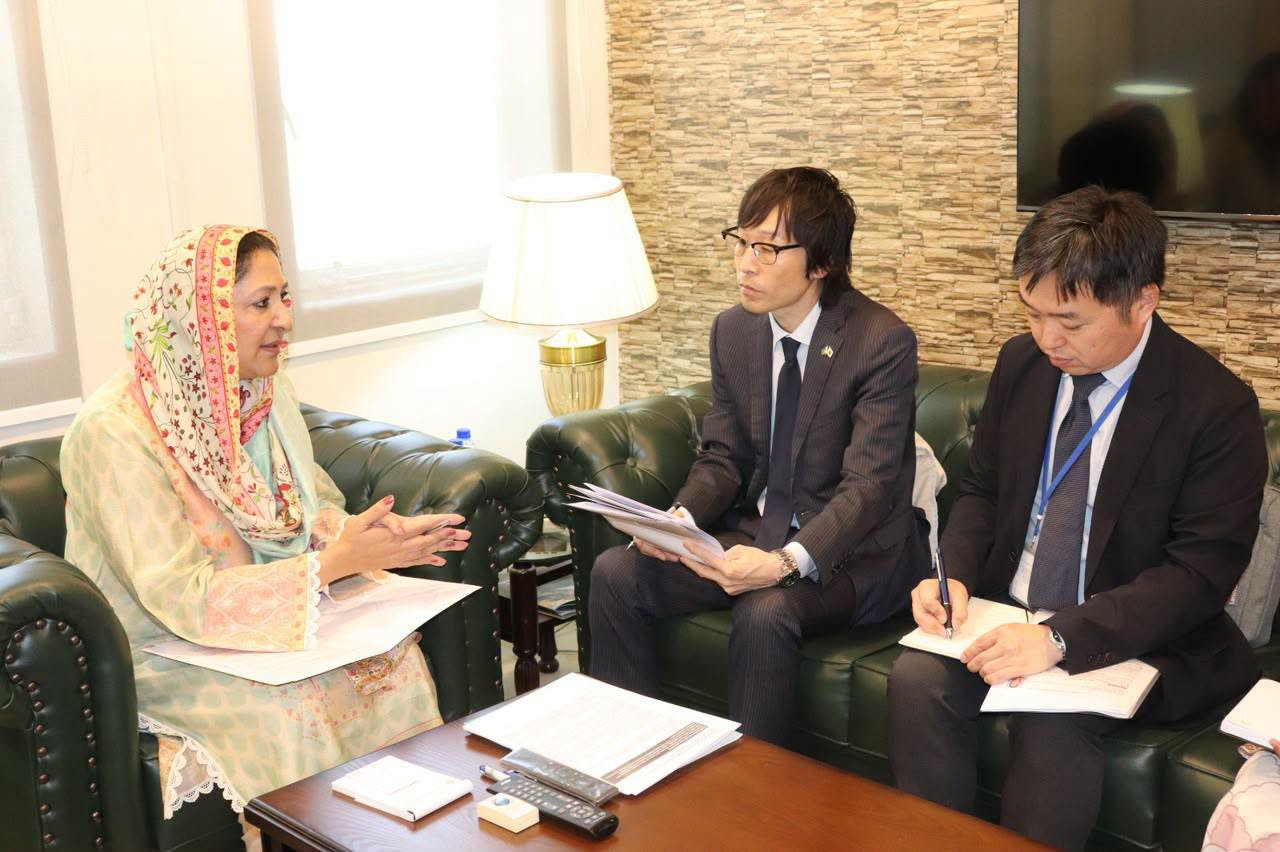
The Minister of State for Federal Education and Professional Training, Ms. Wajiha Qammar, met a delegation from the Japan International Cooperation Agency (JICA) at the Ministry today to review progress on Pakistan's out-of-school children agenda and to chart the next phase of Japan–Pakistan cooperation in non-formal education. The JICA delegation was led by Chief Representative Mr. Shinozaki Yusuke and included Deputy Chief Representative Mr. Sugawara Takayuki, Senior Education Manager Ms. Nazia Sehar, Chief Advisor AQAL Ms. ChihoOhashi and Deputy Chief Advisor AQAL Mr. Abid Gill. The Director General of the Pakistan Institute of Education (PIE) Dr. Zaigham Qadeer Januja also participated. Over three successive phases spanning some twenty years, Japan's cooperation has supported Pakistan's National Non-Formal Education Policy, the Non-Formal Education Management Information System (NFE-MIS), and the Accelerated Learning Programme (ALP) — including its curriculum, learning materials and assessment — together with adult literacy and the Middle Tech pathway linking accelerated learning to vocational certification. The Minister of State placed particular emphasis on that skills pathway. Children leave the system, she noted, not only for financial reasons, but because schooling as currently structured does not equip them for what follows. Under the Middle Tech model, out-of-school children complete a foundational ALP course and progress to technical certification alongside functional English, Urdu and core subjects. “Education, not just certification, but skills — this is the only way forward. Half of our children are not in school. Those who are in school are not learning. Both halves of that problem have to be solved together.” — Minister of State for Federal Education and Professional Training The Minister was equally clear about the form cooperation should take. Rather than successive short project cycles, she called for investment in the permanence of the system itself — in policy, institutions and national data architecture — so that Pakistan can carry the agenda under its own capacity. “The focus should be on strengthening the system, so that we are doing our own work ourselves, and the whole system is there to support it.” — Minister of State for Federal Education and Professional Training The meeting reviewed Pakistan's positioning for Global Partnership for Education (GPE) Multiplier financing, with the Federal Ministry preparing to come forward as a candidate. Preparatory steps discussed included constituting the Local Education Group, developing a Partnership Compact built around the out-of-school children challenge so that formal and non-formal actors work to a shared priority, and applying for the GPE System Capacity Grant. Engagement with other partners — among them UNICEF, the Asian Development Bank, the Islamic Development Bank and the Qatar Foundation — was also reviewed. Participants highlighted progress on identification and tracking. The Federal/ICT door-to-door survey, which mobilised district administration, the health department and university student volunteers to locate out-of-school children, has been shared with Balochistan, where pilot implementation is under way, while Khyber Pakhtunkhwa has completed a pilot in one union council and moved to seek province-wide scale-up. Punjab's work with NADRA on a unique learner identifier was identified for wider adoption. The meeting also discussed establishing a coordination cell and national dashboard at the Pakistan Institute of Education, giving federal and provincial authorities a single view of allocations, implementation and remaining caseload ahead of the Prime Minister-chaired task force. Provinces have endorsed PIE in this coordinating role. JICA reaffirmed its commitment to supporting the Ministry through each stage of this work. “This is a good beginning. We will be working together to combat this challenge.”